Voice AI chatbots are transforming everyday devices into smart assistants that listen, understand, and respond in real time. For businesses, this shift goes beyond novelty—it powers intelligent assistance for call centers, enabling faster resolutions, more personalized interactions, and smoother customer experiences. By leveraging contact center automation and AI in customer service, companies can streamline operations, reduce response times, and deliver service that feels natural, human, and effortless.
The integration of cloud computing platforms with artificial intelligence is expanding the possibilities of what businesses can achieve. Modern computer technology infrastructure, including scalable servers, secure databases, and high-speed networking, allows AI applications to operate efficiently and reliably. This infrastructure supports AI-driven solutions across industries, from customer service to marketing and finance, enabling seamless data flow, intelligent decision-making, and predictive insights.
In the world of business growth, AI-powered digital marketing and online advertising strategies are helping companies analyze customer behavior, personalize communications, and optimize campaigns with greater precision. Tools for automated content creation, audience segmentation, and predictive marketing analytics make it easier to reach the right customers at the right time. Similarly, the financial sector is embracing AI-enabled financial analytics and automated risk management, which allows banks, investment firms, and fintech companies to detect anomalies, forecast trends, automate transactions, and improve overall operational efficiency.
Together, these developments create an integrated ecosystem where voice AI chatbots interact seamlessly with cloud platforms, AI-powered analytics, intelligent marketing tools, and automated financial systems. Businesses can now connect their enterprise technology infrastructure, digital strategy, and customer engagement in ways that were previously impossible, making AI a central part of everyday operations and long-term growth.
This guide walks through what a voice AI chatbot is, how it works, the key benefits, and where forward-thinking companies are using it to gain an edge.
Top 10 Contact Center Solutions for Businesses Leveraging Voice AI Chatbots
When it comes to optimizing customer service, businesses are increasingly turning to voice AI chatbots to provide intelligent, efficient, and human-like interactions. The right contact center solution can streamline operations, improve agent performance, and enhance customer satisfaction. Here’s a look at the top 10 platforms transforming call centers with AI capabilities.
1. Bright Pattern – Intelligent Call Center Solutions
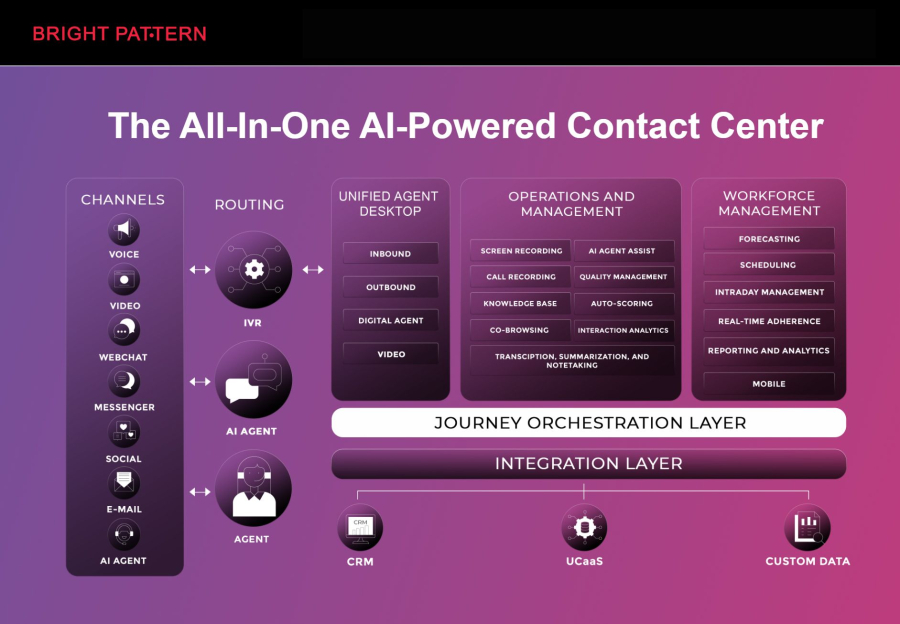 Bright Pattern stands out as a leader in AI-driven contact center solutions, offering an integrated platform designed to improve both customer and agent experiences. Its tools allow businesses to deploy voice AI chatbots across multiple channels, enabling seamless, real-time interactions.
Key Features:
- Omnichannel support including voice, chat, email, and social messaging
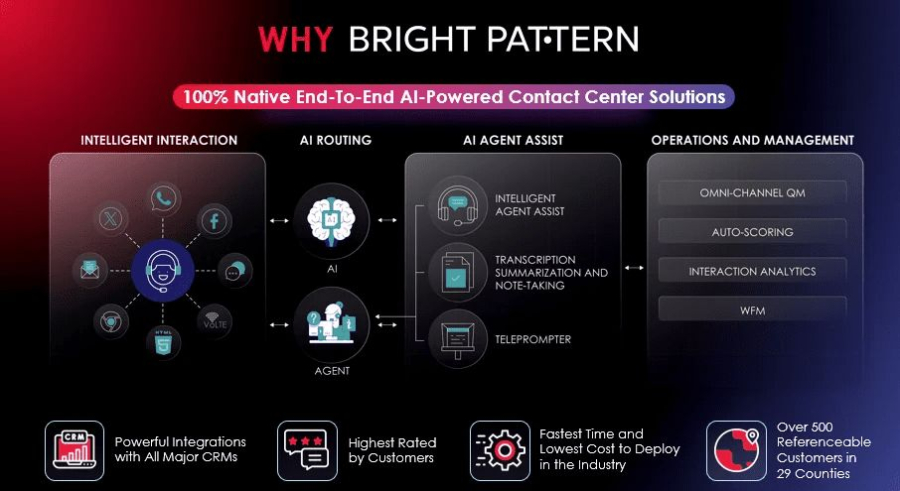
- AI-powered routing and agent assistance for faster resolution
- Real-time analytics and reporting for performance optimization
- Easy integration with CRM systems and business tools
- Scalable cloud-based infrastructure to handle high call volumes
Bright Pattern empowers organizations to implement intelligent call center automation while maintaining a human touch, making it ideal for businesses seeking modern, flexible, and AI-enhanced customer service solutions.
2. Genesys Cloud CX
A robust platform for enterprises, Genesys Cloud CX offers omnichannel capabilities, AI-powered routing, and tools for managing high-volume customer interactions. Its AI features include predictive engagement and virtual assistants to enhance efficiency.
3. Five9 Intelligent Cloud Contact Center
Five9 provides cloud-based contact center software with AI automation for call handling, intelligent routing, and real-time agent assistance. Its AI tools optimize workflows and customer experience across voice and digital channels.
4. NICE CXone
NICE CXone delivers cloud contact center solutions with advanced AI analytics, voice AI chatbots, and automated quality monitoring to help businesses understand and improve customer interactions.
5. Talkdesk CX Cloud
Talkdesk offers a cloud-native platform for seamless customer engagement. Its AI capabilities include virtual agents, workflow automation, and speech analytics for smarter decision-making.
6. Amazon Connect
Amazon Connect is a scalable cloud contact center service with AI-driven features such as chatbots, natural language understanding, and predictive analytics to optimize call center operations.
7. RingCentral Contact Center
RingCentral integrates cloud communications with AI-powered customer service solutions, providing intelligent call routing, automation, and real-time reporting to enhance call center efficiency.
8. Cisco Contact Center
Cisco Contact Center combines AI tools, omnichannel support, and advanced analytics to streamline operations, improve agent productivity, and deliver better customer experiences.
9. 8x8 Contact Center
8x8 provides AI-powered cloud contact center software with voice AI chatbots, sentiment analysis, and automation to help businesses manage customer interactions across multiple channels.
10. Avaya OneCloud
Avaya OneCloud offers a flexible, cloud-based platform with AI-enhanced routing, workforce optimization, and virtual agents that help enterprises deliver smarter, faster, and more personalized customer service.
What Is a Voice AI Chatbot?
Avoice AI chatbotis an application that allows people to interact with software using spoken language instead of typing or tapping. It combines several technologies:
- Automatic speech recognition (ASR)to convert spoken words into text.
- Natural language understanding (NLU)to interpret the meaning and intent behind what was said.
- Dialogue managementto decide how the system should respond and what to do next.
- Text-to-speech (TTS)to convert the chatbot's response back into natural sounding speech.
The result is an experience where customers can simply talk, as they would to a person, and receive instant, relevant assistance at any time of day.
How Voice AI Chatbots Work: From Speech to Smart Action
Behind the scenes, a voice AI chatbot follows a clear sequence whenever a user speaks:
- Listening– The system is activated by a wake word, a button, or a phone call, and begins capturing audio.
- Transcribing– ASR technology converts the audio into text, handling accents, speech speed, and background noise as accurately as possible.
- Understanding– NLU models analyze the text to detect the user's intent and extract key details, such as names, dates, or product codes.
- Deciding– Dialogue management determines the next step: answer a question, ask for clarification, perform an action in another system, or route to a human.
- Acting– The chatbot might update a booking, look up account information, or trigger a workflow in an external system.
- Responding– TTS turns the chatbot's response into natural speech, and the user hears an immediate, context aware reply.
All of this happens in seconds, allowing for fluid, back and forth conversations that feel far more effortless than traditional chat or forms.
The Business Case for Voice AI Chatbots
Adopting a voice AI chatbot is not just about keeping up with trends. It delivers clear, measurable value across customer experience, operations, and revenue.
1. Faster, More Convenient Customer Experiences
Voice is the most natural interface for humans. We learn to speak long before we learn to type. A voice AI chatbot lets customers:
- Get answers instantly, without navigating menus or waiting on hold.
- Multitask easily, speaking while driving, cooking, or working.
- Avoid friction, skipping long forms, logins, or complex navigation.
For businesses, this translates into shorter handling times, higher completion rates, and more satisfied customers who feel understood and supported.
2. 24 / 7 Availability Without Scaling Headcount
Human teams have limits. A voice AI chatbot can engage customers:
- Around the clock, across time zones and holidays.
- At any volume, handling spikes in demand without long queues.
- Across channels, from phone lines to mobile apps and smart devices.
This always on presence reduces pressure on support teams while keeping customers connected whenever they need help.
3. Lower Costs per Interaction
By automating routine conversations, voice AI chatbots significantly lower the cost of support and service:
- They can resolvefrequent, repetitive queriessuch as order status, account balances, store hours, or appointment scheduling.
- Theyshorten call durationby gathering information before a human takes over, if escalation is needed.
- Theyreduce call abandonment, as customers get help quickly instead of hanging up.
These efficiencies free human agents to focus on higher value, more complex conversations where human empathy and judgment make the biggest impact.
4. Higher Customer Satisfaction and Loyalty
When implemented thoughtfully, voice AI chatbots actually improve how customers feel about your brand. Key drivers of satisfaction include:
- Consistency– The chatbot gives the same accurate information every time.
- Personalization– Integrated with your systems, it can greet customers by name, remember preferences, and tailor recommendations.
- Control– Customers can quickly get things done on their own terms, without waiting for office hours.
Over time, this leads to stronger loyalty, more repeat purchases, and higher lifetime value.
5. Rich Data for Continuous Improvement
Every voice interaction is a source of insight. When properly collected and analyzed, these conversations reveal:
- Common pain pointscustomers face during onboarding, purchasing, or support.
- Emerging needs and trendsthat can inform product and service enhancements.
- Language customers actually use, which can refine your messaging, knowledge base, and training materials.
This data driven feedback loop helps you continuously refine both the chatbot and your overall customer experience strategy.
Key Features to Look For in a Voice AI Chatbot
Not all voice AI chatbots are created equal. When evaluating solutions, it helps to focus on a few core capabilities that drive performance and user satisfaction.
Natural, Human Like Speech Recognition
High quality ASR should handle:
- Different accents and dialects, without constantly asking people to repeat themselves.
- Everyday language, including filler words and slight mistakes.
- Background noise, such as traffic, office sounds, or home environments.
The more natural the recognition, the less friction users feel and the more confident they become in using the system.
Robust Natural Language Understanding
A powerful NLU engine can interpret what users want even when they phrase it differently. Look for the ability to:
- Support multiple intentsin one sentence, such as changing an appointment and updating contact details.
- Extract entitieslike dates, locations, order numbers, and product names reliably.
- Handle context, remembering details across multiple turns in a conversation.
This is what moves the chatbot from rigid scripts to flexible, conversational interactions.
Natural, Brand Aligned Voice Responses
Text to speech quality has improved dramatically. A strong voice AI chatbot should provide:
- Clear, pleasant voicesthat are easy to understand over phone lines or speakers.
- Appropriate tonefor your brand, whether friendly, professional, or reassuring.
- Adaptive pacing and emphasisso important information stands out.
This matters for accessibility as well, helping visually impaired users or those who prefer listening to reading.
Easy Integration with Existing Systems
To be truly useful, your voice AI chatbot should connect seamlessly with your technology stack. Essential integration points often include:
- Customer relationship management (CRM)systems for personalized interactions.
- Order management and billingfor status checks and payments.
- Knowledge bases and FAQsto deliver consistent, up to date information.
- Contact center platformsto route calls and pass context to human agents when needed.
These connections allow the chatbot to complete real tasks, not just answer basic questions.
Analytics and Continuous Optimization
Strong analytics capabilities are essential for improving performance over time. Ideally, your solution should offer:
- Conversation transcriptsfor review and training.
- Key metricssuch as containment rate, average handle time, and customer satisfaction.
- Tools to refine intents and flowsbased on real usage patterns.
This creates a cycle of ongoing optimization that increases automation rates and user satisfaction month after month.
Top Use Cases for Voice AI Chatbots
Voice AI chatbots are flexible across industries and functions. Here are some of the most impactful ways organizations are using them today.
Customer Service and Support
In customer service, voice AI chatbots can:
- Answer common questionsabout orders, accounts, and policies.
- Guide troubleshootingfor technical products or services.
- Provide status updateson deliveries, repairs, or applications.
- Escalate intelligentlyto a human agent when the issue is complex.
This blend of automation and human support creates a more responsive and efficient service model.
Sales and Lead Generation
Voice AI chatbots are increasingly part of the sales journey, where they can:
- Qualify leadsby asking a few targeted questions and capturing contact details.
- Recommend products or plansbased on customer needs and preferences.
- Schedule demos or appointmentsdirectly during the call.
By engaging prospects in real time, they reduce drop off and help sales teams focus on high potential opportunities.
Banking and Financial Services
In finance, security and clarity are critical. Voice AI chatbots can safely support tasks like:
- Checking balances and recent transactions.
- Paying billsand setting up recurring payments.
- Explaining fees or account featuresin simple language.
- Providing branch and ATM informationbased on the customer location.
With appropriate authentication and compliance controls, these experiences feel both convenient and trustworthy.
Healthcare and Appointments
Healthcare organizations use voice AI chatbots to reduce administrative burden and improve patient access:
- Booking, rescheduling, or cancelling appointmentswithout waiting on hold.
- Sending voice remindersfor upcoming visits or medication schedules.
- Answering pre visit questionsabout preparations or required documents.
Patients benefit from faster, easier access to care, while staff gain more time for direct patient interaction.
Travel, Hospitality, and Transportation
In travel and hospitality, time and clarity are everything. Voice AI chatbots can:
- Provide real time updateson flights, trains, or reservations.
- Assist with bookingsfor rooms, tables, or tickets.
- Answer location based questionsabout check in times, amenities, or local recommendations.
Guests enjoy smoother journeys and less stress, while providers reduce the load on front desk and call center teams.
Designing a Voice AI Chatbot Experience That Users Love
The technology matters, but so does the experience design. A well designed voice AI chatbot feels intuitive, respectful, and easy to use.
Use Natural, Clear Language
Write prompts and responses in everyday language. Aim for:
- Short, simple sentencesthat are easy to process by ear.
- Direct questionsthat guide the user step by step.
- Friendly, professional tonethat matches your brand.
Avoid heavy jargon or long lists of options unless absolutely necessary.
Set Expectations Up Front
From the beginning of the interaction, explain what the chatbot can do and how it can help. For example, it can say it can help with billing questions, appointment changes, or product information. Clear expectations reduce frustration and encourage users to try specific tasks.
Design for Errors and Clarification
No voice system is perfect. Plan for moments when the chatbot does not fully understand. Effective strategies include:
- Polite re promptsthat ask the user to repeat or rephrase.
- Confirmationsfor critical information such as amounts, dates, or personal details.
- Graceful handoffs to humanswhen the system reaches its limits.
This keeps interactions smooth and maintains user trust even when misunderstandings occur.
Maintain Context Across Turns
One of the biggest advantages of a conversational interface is the ability to handle context. Make sure your voice AI chatbot:
- Remembers relevant detailswithin a session, so users do not have to repeat themselves.
- Uses previous answersto ask smarter follow up questions.
- Summarizes key pointsbefore completing actions.
This creates a feeling of fluid conversation rather than a series of disconnected questions.
Implementing a Voice AI Chatbot: Practical Steps
Launching a successful voice AI chatbot is a structured process. The following steps help make sure you move from idea to impact with confidence.
1. Define Clear Objectives
Start with specific goals rather than technology for its own sake. Examples of strong objectives include:
- Reduce average call wait time by a certain percentage.
- Automate a given share of routine customer service interactions.
- Increase self service usage for specific tasks such as order tracking.
Clear goals help you choose the right use cases, measure success, and gain internal support.
2. Prioritize High Impact Use Cases
Begin with scenarios that are frequent, structured, and meaningful. Ideal starting points include:
- Frequently asked questions that follow predictable patterns.
- Simple transactions, such as appointment booking or order status.
- Information updates, such as address changes or password resets.
These use cases deliver quick wins, demonstrate value, and create a foundation for more advanced capabilities.
3. Map the Conversation Flows
Before building, sketch out conversational paths. Consider:
- How users might phrase requestsin multiple ways.
- What information you need to collectto complete each task.
- Where to offer shortcutsfor experienced users.
- When to offer a human handofffor complex or sensitive issues.
Planning flows visually helps you design more intentional and coherent experiences.
4. Integrate with Back End Systems
Connect the voice AI chatbot to the systems that store your data and drive your processes. This is what enables real task completion, such as:
- Looking up customer records and personalizing responses.
- Updating information directly from the conversation.
- Triggering workflows such as order changes or support tickets.
Close collaboration between IT, operations, and customer facing teams is key at this stage.
5. Test With Real Users
Before a full launch, run pilot programs or beta tests with a segment of your audience. Observe:
- Which phrases users naturally choose for key tasks.
- Where misunderstandings or dead ends occur.
- How often humans need to step in.
Use this feedback to refine intents, responses, and flows. The goal is a smooth, intuitive experience that reflects how your customers actually speak.
6. Monitor, Measure, and Improve
Once live, treat your voice AI chatbot as a product that evolves over time. Track metrics like:
- Containment rate, or the percentage of interactions resolved without human intervention.
- Average handle time for automated and assisted conversations.
- Customer satisfaction scores or surveys after interactions.
Regularly review transcripts to identify new needs, adjust flows, and expand the chatbot's knowledge. Continuous improvement keeps the experience fresh, relevant, and increasingly valuable.
Addressing Common Concerns
As organizations explore voice AI chatbots, a few questions consistently come up. Thoughtful planning can turn these concerns into strengths.
Will a Voice AI Chatbot Replace Human Agents?
In practice, voice AI chatbots are most powerful when theyaugmenthuman teams rather than replace them. They take on routine inquiries and repetitive tasks, while agents handle nuanced cases that require empathy, complex problem solving, or negotiation. This division of labor creates better experiences for both customers and employees.
What About Privacy and Security?
Responsible voice AI implementations prioritize privacy from the start. Best practices include:
- Clear disclosuresthat conversations may be recorded and analyzed to improve service.
- Data minimization, collecting only what is necessary for the task at hand.
- Secure storage and access controlsto protect sensitive information.
- Compliance with relevant regulationsin your region and industry.
These safeguards build trust and allow customers to enjoy the benefits of automation without compromising their privacy.
How Do We Maintain Our Brand Voice?
Your voice AI chatbot is an extension of your brand. To keep it aligned with your identity:
- Define tone guidelines, such as warm, expert, or playful.
- Review and edit key responsesto match your writing style.
- Choose voicesthat reflect your brand personality and audience preferences.
Consistent, well crafted language helps your chatbot feel like a cohesive part of your overall experience, not an add on.
The Future of Voice AI Chatbots
Voice AI chatbots are evolving rapidly. Ongoing advances in machine learning, language models, and hardware are making them more capable, more accurate, and more intuitive every year.
Trends shaping the future include:
- More proactive assistance, with chatbots offering help based on context instead of waiting for users to ask.
- Richer multimodal experiences, combining voice with on screen visuals for complex tasks.
- Deeper personalization, where past interactions shape future conversations in meaningful ways.
- Broader accessibility, helping users with disabilities or limited digital skills navigate services more easily.
Organizations that invest now in voice AI capabilities will be well positioned to harness these developments and set new standards for effortless, human centered service.
Conclusion: Turning Conversation Into a Competitive Advantage
Voice AI chatbots are more than a trend. They are a practical, powerful way to simplify customer journeys, reduce costs, and unlock new forms of value. By allowing customers to simply speak and be understood, they bridge the gap between human expectations and digital systems.
When you design thoughtfully, integrate deeply, and improve continuously, a voice AI chatbot becomes a strategic asset that delights customers, empowers teams, and differentiates your brand. The organizations that embrace this conversational future today are the ones shaping tomorrow's customer experience standards.
